CoRL 2026Open-world mobile manipulation

LOOK BEFORE YOU MOVE

Agent-Interface-Aligned Supervision for Open-World Mobile Manipulation

01 / The idea

COLLECT DEMONSTRATIONS
THROUGH THE AGENT INTERFACE.

AIDA constructs demonstrations through the same high-level skill interface used by the deployed agent. Teacher decisions drive collection, making active visual behavior part of the supervision.

How demonstrations are generated

AIDA

The teacher directly generates high-level actions in a closed loop.

01 / OBSERVE

Current Obs oₜ

Observe the environment.

02 / DECIDE

Teacher decision

Choose a skill + parameters.

03 / EXECUTE

High-level action

Execute the selected skill.

RECORDED DATA

Teacher demonstrations

o₁Search(k)
o₂Nav(u, v)
o₃Pick(u, v)

Observations + skill labels

02 / Task & system

DUAL SYSTEM FOR
MOBILE MANIPULATION

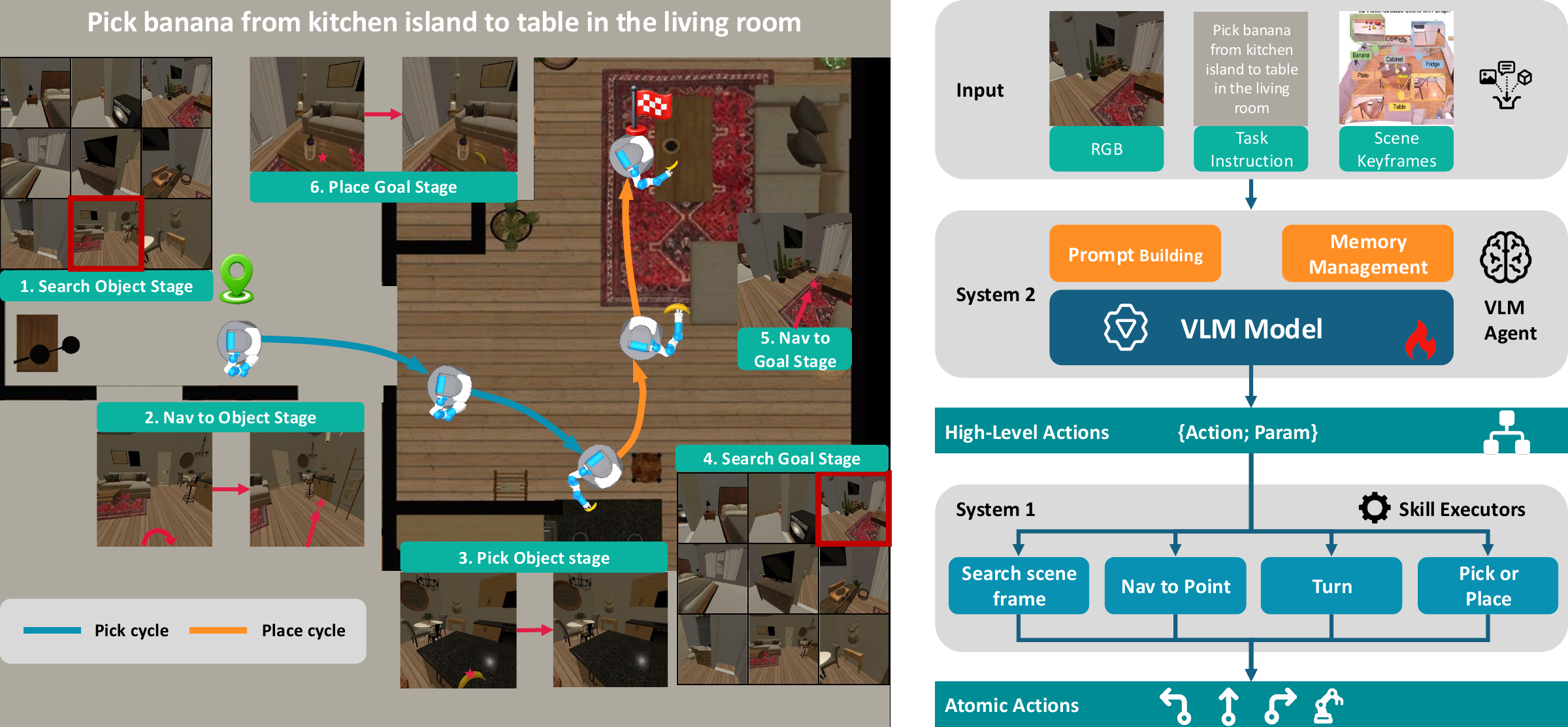
The agent transfers an object to a target receptacle in a pre-mapped environment, using a list of scene key frames with known camera poses. A VLM predicts high-level skills and their parameters; low-level controllers execute the corresponding robot motions.

Task instruction“Pick banana from kitchen island to table in the living room.”
Full OWMM task and system figure with pick and place cycles, VLM inputs, memory, and skill executors.
01

Search

search_scene_frame(id)

Select a scene key frame. Navigate to its associated pose.

02

Turn

turn(angle)

Rotate in place to adjust the robot’s view.

03

Approach

nav_to_point(u, v)

Select an image point. Depth and camera pose ground the navigation destination.

04

Pick

pick(u, v)

Select a point on the object for the controller to grasp.

05

Place

place(u, v)

Select a destination point for the controller to place the held object.

03 / Methods

BUILDING THE AGENT’S
TRAINING DATA.

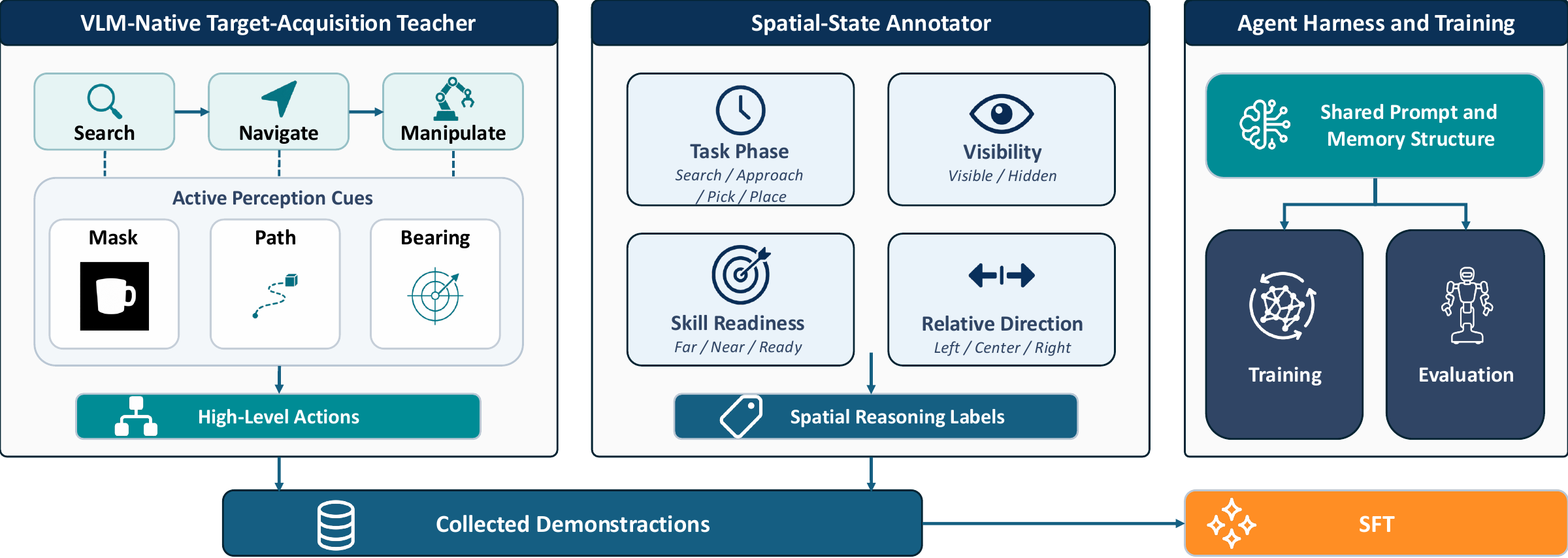
AIDA builds training examples through the agent’s skill interface. The teacher provides skill and parameter targets; the offline annotator adds pre-action reasoning targets. The shared harness assembles input prompts and episode memory, with a consistent output schema for training and deployment.

Full method figure showing target-acquisition teacher, spatial-state annotator, and shared harness and training.
01

Active teacherOUTPUT · SKILL + PARAMETERS

The teacher selects and executes skill calls through the student’s interface, using simulator state during collection. It turns to acquire or recover targets, keeps them in view during approach, and moves within reach for picking or placing. Each executed skill and its parameters become action supervision.

02

Spatial-state annotatorOUTPUT · PRE-ACTION REASONING

After collection, deterministic templates use recorded simulator information to describe target visibility, relative direction, skill readiness, and task progress. These annotations form the reasoning targets that the student learns to produce before predicting a skill and its parameters.

03

Shared agent harnessINPUT · PROMPT + EPISODE MEMORY

The harness assembles prompts with the instruction, current image, skill definitions, and prior calls, parameters, and step summaries. Search prompts also include scene key frames. It pairs prompts with annotated outputs for training, then maintains the same format and updates memory during deployment.
04 / Experimental evidence

FROM DEMONSTRATIONS
TO COMPLETED TASKS.

We evaluate task completion, compare demonstration sources and teacher behaviors, and examine the role of the harness before testing real-robot deployment.

OWMM benchmark

71.76%

Full-task success

82.35%

Object picked

90.59%

Object-image retrieval

AIDA-OWMM · Qwen3-VL-8BOWMM-VLM-38B · InternVL-38B

Success through the task

Sequential milestones →
TEACHER SENSITIVITY

AIDA improves on trajectory-derived data.

All three AIDA teachers outperform chunk-derived supervision. Active visual behaviors further improve success.

Shared model, training setup, four skills (no turn), reasoning labels, and harness. AIDA: mean of three evaluations.

HARNESS ABLATION

Context and spatial supervision support action.

Key framesHistoryReasoningSuccess
Every stageNoneNo55.88%
SearchNoneNo60.00%
SearchActionsNo65.88%
SearchActionsYes71.76%

Same AIDA demonstrations and five skills. The final configuration adds spatial reasoning and step summaries.

05 / Real-robot deployment

TRAINED IN SIMULATION.
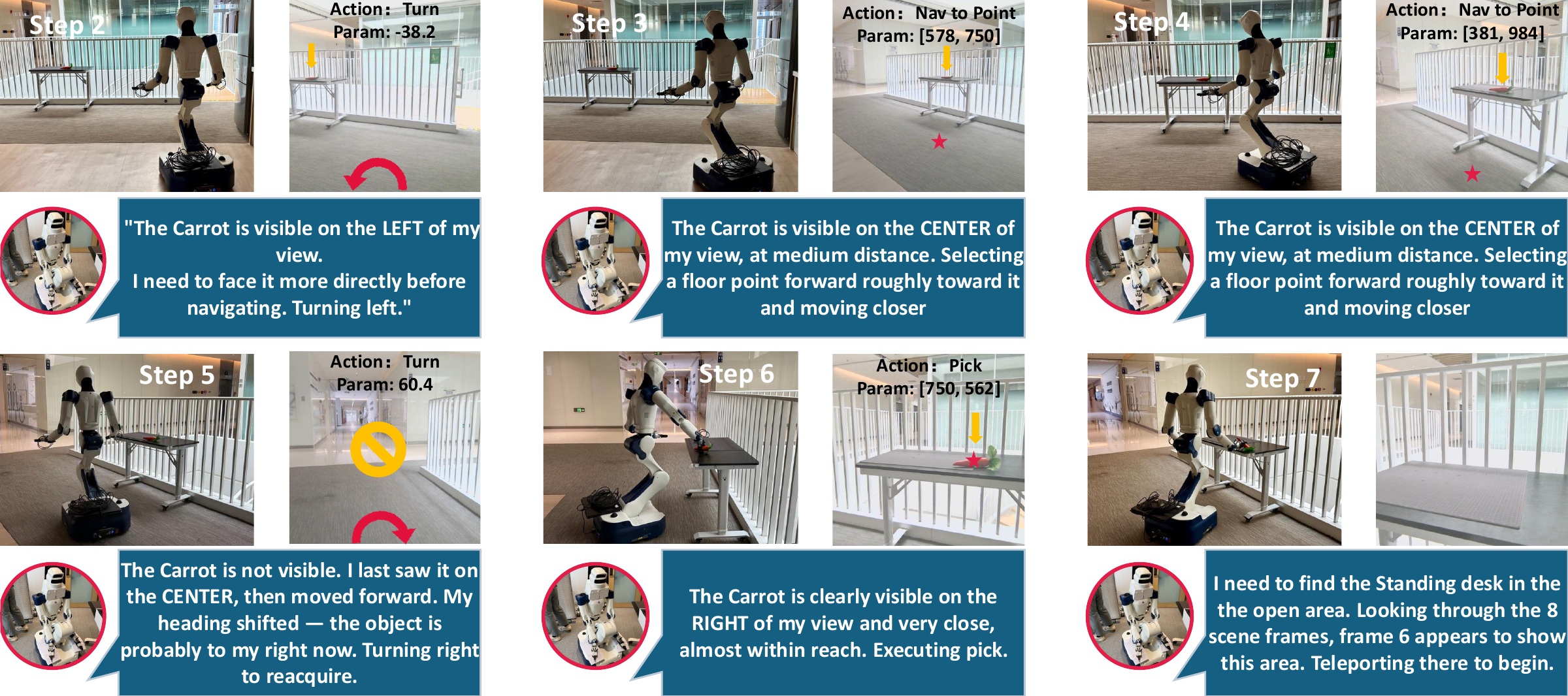
ACTING IN THE OFFICE.

38%End-to-end success

AIDA-OWMM runs on Atribot S1 without additional model training, using the same high-level skill interface.

Complete real-robot qualitative figure, steps 2 through 7, showing turning, approach, target recovery, pickup, and receptacle search.